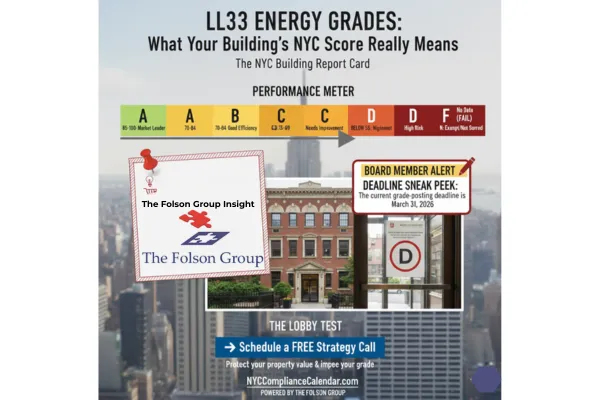
LL33 Energy Grades: What Your Building’s NYC Energy Score Really Means
What Local Law 33 Is — And Why Those Big Letter Grades Matter
Local Law 33 (LL33) is the NYC energy law that turns raw energy and water usage data into a simple letter grade — the kind people actually see when they walk into your building. Passed in 2018, LL33 requires large buildings that must benchmark under Local Law 84 to publicly display an energy grade label near each public entrance every year based on the energy score generated by benchmarking data.
Think of it like the restaurant health grades you see in the window — except this one tells everyone how efficiently your whole building uses energy.
🅰️🅱️🅾️ How the Grades Work
Under LL33 (as implemented and clarified by Local Law 95), the grade directly reflects your building’s ENERGY STAR® score from benchmarking:
A — 85 or higher — strong efficiency
B — 70 to 84
C — 55 to 69
D — below 55
F — your building failed to submit required benchmarking data
N — exempt or not scored under EPA standards (NYC Government)
These grades are recalculated annually based on the most recent benchmarking submission.
Why the Grade Is Hard to Ignore
Picture this: you walk up to your building every day — and twice you see that grade printed on an official label near the door. It’s hard to miss. Just like in school, coming home with a D or F wasn’t fun — and it’s no different when it’s hanging right on your lobby wall for everyone to see.
That visibility isn’t accidental. The city designed LL33 to:
Raise transparency about how buildings perform
Let residents, buyers, and tenants compare properties quickly
Encourage owners to improve efficiency over time
Reinforce energy goals tied to broader climate plans like Local Law 97
Unlike benchmarking (LL84), which lives behind the scenes, LL33 brings performance into the open — making it social and market pressure, not just compliance.
Why Some Buildings Get “Ugly” Grades
A “D” or “F” grade doesn’t automatically mean a bad building — it often reflects underlying challenges:
Mixed or High-Use Spaces
If part of your building operates 24/7 a grocery store, commercial kitchen, or cold storage — those refrigerators and freezers run constantly. They use huge amounts of energy, and that usage gets rolled into the building’s total benchmarking data.
Because the ENERGY STAR score compares your building’s energy use to similar buildings, heavy retail use can pull an otherwise efficient residential building’s grade down — even if the co-ops live like energy saints.
That’s especially visible in NYC, where mixed-use buildings with retail tenants are common.
Posting Requirements Make It Stick
LL33 doesn’t just calculate these grades — it makes you show them:
The NYC Department of Buildings issues the official label every year around October 1.
Buildings must post the label near each public entrance (visible to passersby) by October 31 - in 2025, this deadline was extended to March 31, 2026.
Labels must stay up until replaced the following year.
If you fail to post or display correctly, NYC can issue a DOB violation and a fine (e.g., ~$1,250).
That means residents, delivery drivers, brokers, and anyone walking by gets to see your grade upfront.
What the Grade Doesn’t Tell You
LL33’s energy grade is not a perfect measure of:
Your building’s carbon emissions (that’s LL97’s focus),
Whether your building is structurally efficient,
Whether your utility bills are low — it’s relative to similar buildings, not absolute,
Or the distribution of energy use across different parts of the building — big retail loads can skew scores.
In other words, a “C” isn’t a condemnation — it’s a snapshot of performance relative to peers based on usage patterns.
Bottom Line
Local Law 33 energy grades put performance front and center — right on your entrance — and make benchmarking real for residents, buyers, and the public.
Sometimes the grade is flattering. Other times it’s an “ugly” D that feels just like that disappointing report card in school — especially if parts of the building have heavy energy demand like a 24/7 grocery tenant.
It’s not just about compliance — it’s about visibility, perception, and ultimately, business performance.
Want to talk about your building’s energy grade and how it can be improved?
👉Schedule a quick Strategy call with our team.


